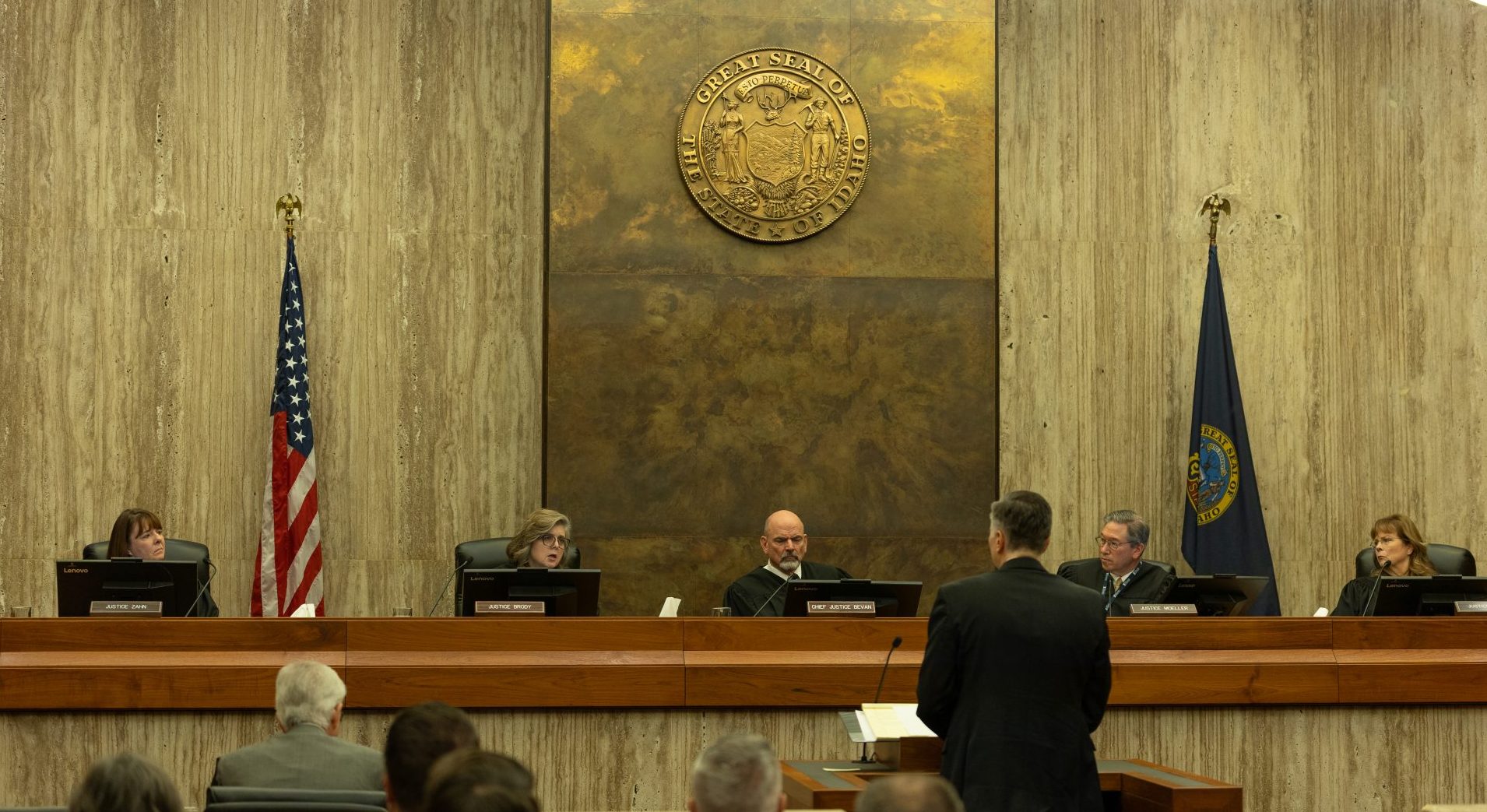
Kollman’s attorney, Kristian Beckett, argued that the Idaho law’s five-day timeline should apply unless there’s another applicable timeline.
In this instance, Beckett argues, 45 days is a “maximum outer limit,” not a minimum requirement, and the intent of Idaho’s law is to provide more rights than the federal government to Gem State residents.
The minimum requirement in FERPA is that records be provided within a reasonable timeline, Beckett argued, which Idaho law prescribes as five days.
The U.S. Department of Education recognizes states may require access within a shorter period of time, Beckett noted.
Justices questioned Beckett’s reading of the law, asking if he’s arguing the law is ambiguous about what “unless” means.
Beckett said “unless” could be read multiple ways. However, he argued that the word “specific” means a specific timeline, and that FERPA only has a maximum guideline, not a specific timeline.
The district’s attorney — Anne Mageneli, with Anderson, Julian & Hull — argued the lower court judge correctly dismissed Beckett’s filing because another law, FERPA, applies.
Mageneli said there’s not a carve-out in the Idaho parental rights law for districts to ask for more time. She pointed to the Idaho Public Records Act, which allows government entities to ask for a 10-day extension to the initial three-day window if a request is time-intensive.
The Idaho Parental Rights Act’s “release valve appears to be if there’s another timeline that applies,” she said. “I do not believe that courts, including the lower court, can legally read in ‘unless there’s another timeline’ to mean unless there’s another shorter, more strict timeline, which I believe is what the lower court was being asked to do.”
Mageneli also referenced the nature of Kollmann’s request. Kollmann asked the district for all records related to his daughter. That required redaction of video footage to protect the privacy of other students, which takes time, Mageneli said.
When asked if the problem could have been avoided if Muir, then-superintendent, had tried to defuse the situation, Mageneli acknowledged he could have handled the incident better.
“He’s no longer the superintendent for some reasons that may include that,” Mageneli said.
Mageneli also noted that Kollmann had clashed with the district before, including when he sought legal action.
Soda Springs has had multiple special education violations, the Idaho Department of Education found last year.
The Idaho Supreme Court has yet to rule on the arguments. Listen to a recording of the oral arguments here.